The leaf becomes four quite different things, and most of the volume never reaches a teapot.
- The cup Bagged and loose leaf, red and green, plus espresso-ground and lattes
- The kitchen Used as a cooking liquid and in baking
- Cosmetics Extract in skincare — a large category by search demand
- Extract trade Sold into Europe, Asia, North America and Australasia
- Not here No health claims. Composition yes, effect no
In the cup
The teabag is the smallest thing rooibos does. Because the leaf is caffeine‑free and holds its colour under milk, it has been pushed into almost every format a coffee shop already owns — which is why you can order a rooibos cappuccino in a city that has never seen the plant growing.
Read the restAbout 2 minutes
The South African Rooibos Council — the industry body, and the best available source on what actually exists — lists all of the following as things being sold today.
-
Loose leaf and teabagsThe oxidised red leaf, and the unoxidised green leaf — a different product made from the same bush.SANBI · SA Rooibos Council
-
Rooibos espressoLeaf ground fine enough to brew on standard espresso equipment. red espresso says it made the first, in 2005, and that its signature drink is the “red cappuccino”.red espresso, the company’s own words
-
Rooibos latte and cappuccinoSold hot or iced in coffee shops. The Council names both, in those exact words.SA Rooibos Council FAQ
-
Iced rooibosBottled and canned, in flavours including apple, lemon and pineapple. BOS Brands describes itself simply as “Rooibos Tea & Ice Tea from South Africa to the World”.SA Rooibos Council · BOS Brands
-
Green rooibos chaiSpiced, and made from the unoxidised leaf rather than the red.SA Rooibos Council FAQ
-
Instant rooibosSoluble powder rather than leaf. Made, though far less visible than the teabag.SA Rooibos Council FAQ
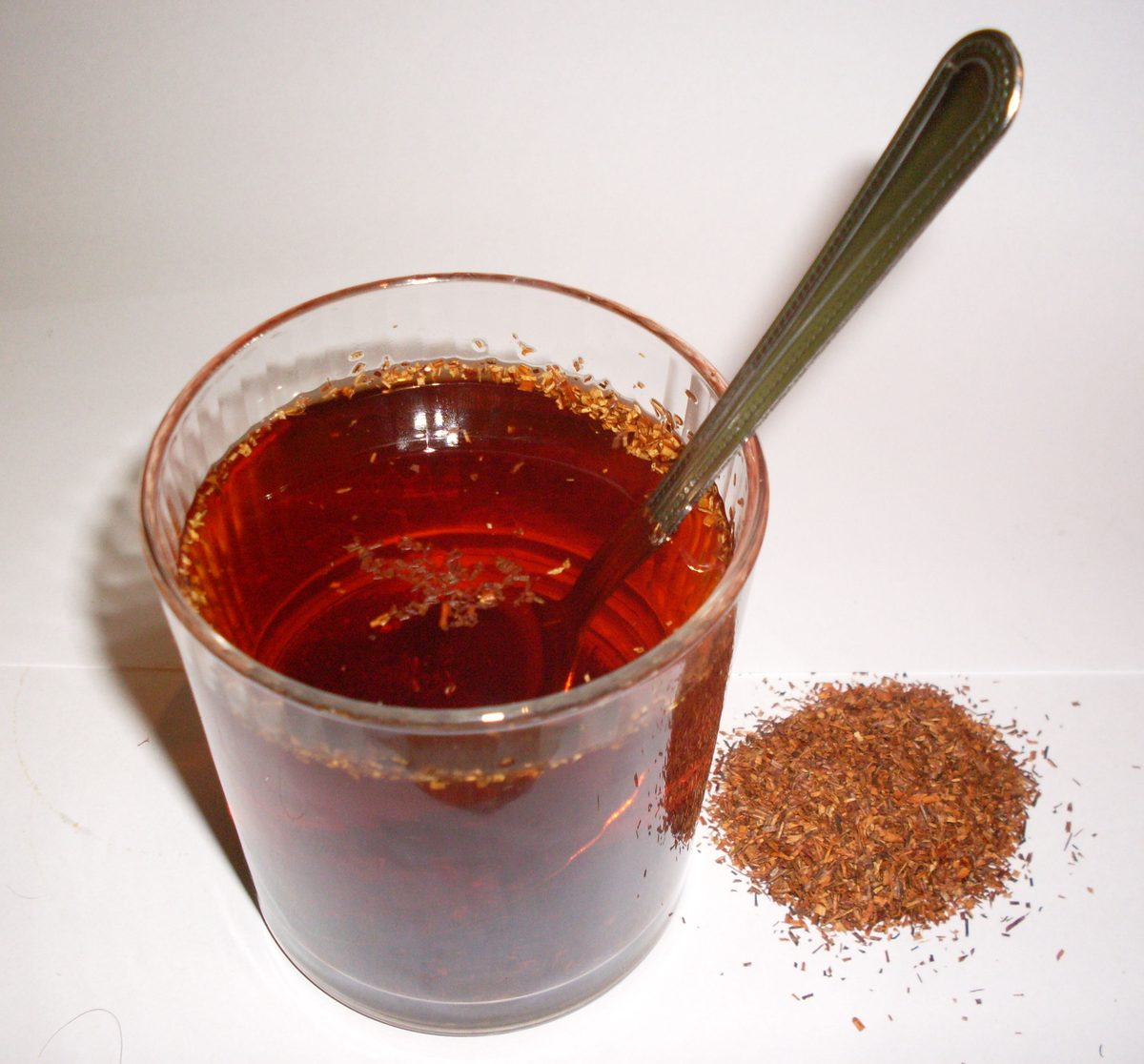
Rooibos is a legume from the Cape fynbos, not a tea bush, so nothing about an espresso machine is native to it. What makes the format possible is mechanical: the leaf can be cut fine, it brews dark, and it carries milk.
In the kitchen
Rooibos gets into food in two different ways, and they are worth separating. In a home kitchen it goes in as brewed tea. In a factory it goes in as extract — a standardised liquid or powder, which is a different trade entirely and has its own section below.
-
Stews and marinadesThe Council’s own suggestion, in its own words: use rooibos “as a basis for stews and marinades”.SA Rooibos Council FAQ
-
Juices, yoghurts and sweetsMade with rooibos extract rather than brewed leaf, and sold as ordinary supermarket products.SA Rooibos Council FAQ
-
Baked goods, dairy and saucesNamed by the Council as established uses of the extract in food manufacturing.SA Rooibos Council, 2025
-
Rooibos ice-creamReported by the Council as served at some hotels. We have not verified a single venue, so we do not name one.SA Rooibos Council — soft, unconfirmed
-
Rooibos-infused wineThe Council names Stellar Winery’s organic “Heaven-on-Earth”. We have not checked this against the producer.SA Rooibos Council — soft, unconfirmed
-
Flavoured water and energy drinksFunctional beverages built on rooibos extract — a manufacturing input, not a brewed cup.SA Rooibos Council, 2025
The industry body describes many of these products in terms of what they are supposed to do for a body. This site reports that the products exist, and nothing further. We publish no health claim about rooibos in any form — not for tea, not for a supplement, not for a cream. Composition, such as being caffeine‑free, is a fact and is on the site. Effect is not.
On the skin
Cosmetics are the second-largest thing rooibos becomes, and almost none of it involves the leaf in a recognisable form. Formulators work with standardised extract, so what reaches a shelf in Tokyo or Berlin is consistent in a way a farmed crop never is.
Read the restAbout 1 minute
-
Soap, foam bath and bath saltsNamed in the Council’s own list of rooibos body and household products.SA Rooibos Council FAQ
-
Body scrub, moisturisers, toners, facial masksThe Council lists all four by name.SA Rooibos Council FAQ
-
Skin, hair and nail careAn entire retail category. African Extracts, in Paarden Eiland, Cape Town, sells a rooibos skincare range of seven lines.SA Rooibos Council, 2020 · African Extracts
-
Make-up and fragranceRooibos extract goes into colour cosmetics and perfumery. Bvlgari’s “Eau Parfumée au Thé Rouge” is named by the Council as carrying rooibos notes; we have not confirmed that with Bvlgari.SA Rooibos Council — the Bvlgari detail is soft
The Council states plainly that most green rooibos is exported, and that it is used both as a tea and “in extract form in beauty and nutraceutical products”.
So the more expensive, harder-to-make version of the leaf largely leaves the country to become something other than a cup of tea.
The extract trade
If you are here as an importer or a formulator rather than a visitor, this is the part that matters. Rooibos extract is a commodity input, standardised so it can be dosed into a recipe, and it sells into markets that mostly never see a teabag.
Read the restAbout 1 minute
| Sector | What the Council namesIts own wording, quoted |
|---|---|
| Food and beverage | “teas and infusions, flavoured water, energy drinks and functional beverages”; also “baked goods, dairy products and sauces” |
| Cosmetics | Skincare and haircare formulations, “from anti-ageing creams to soothing balms” |
| Nutraceuticals | Supplements.The Council also names pharmaceuticals as a potential future application. That is its claim, not our finding, and we make no statement about what any of it does. |
| Export regions | “Europe, Asia, North America, Australia and New Zealand” |
The Council puts the green rooibos extract market at about USD 141 million, growing at 6.3% a year to roughly USD 227 million over five years. It does not name the underlying research, and it is an industry body with an interest in the number being large. We publish it as what the Council says, hedged, rather than as a fact about the market.
- South African Rooibos CouncilThe industry bodyWhere nearly every product claim on this page comes from. If you are sourcing commercially, start with them, not with us.
Around the house
The last group is the one nobody markets, because it mostly uses what is left over.
-
Room and linen freshenersListed by the Council alongside the household range.SA Rooibos Council FAQ
-
Natural dyeUsed for colour, in the Council’s words, “due to its rich red colour”. The same pigment that makes the cup red.SA Rooibos Council FAQ
-
Spent leaf in the gardenWidely passed around as a soil amendment and pest deterrent. That is household advice rather than a tested claim, and we pass it on as exactly that.SA Rooibos Council — unverified
What we cannot tell you yet
This page is a catalogue of what exists, drawn from the industry body and from companies’ own descriptions of themselves. Four things are deliberately missing.
- How any of it tastes. We have not tasted these products, and we do not describe flavour from other people’s notes.
- What any of it does to you. No health claim, for any rooibos product, in any form. That is a standing rule here, not a gap we intend to close.
- What any of it costs. No price appears on this site until someone has confirmed it.
- Where to buy it in the region. Which farm stalls, co-operatives and shops actually sell what, and on which days, needs field research. Until that is done we would be guessing, and a guess sends you down a dirt road for nothing.
Everything here starts as the same leaf
Tea, espresso, iced tea, food, cosmetics and industrial extract. What changes is not the plant but what is done to it after the cut.